Answers to Questions
Here are some common questions we often get asked. Please get in touch for any questions you may have.
How do I know if a professional is fully qualified?
Play Therapy is a postgraduate qualification. It is important to check that your therapist is fully qualified and professionally registered. There are several ways to check this, and it is always safest to check before going ahead with anyone for your child or yourself. Different professions have different membership bodies; here are some below.
How to search for a fully qualified Play Therapist, Psychologist, Counsellor, Psychotherapist or Child Counsellor etc.
https://playtherapyregister.org.uk/search-listings/
https://www.bapt.info/play-therapy/register/
https://www.hcpc-uk.org/check-the-register/
https://www.professionalstandards.org.uk/organisations-we-oversee/find-a-register
https://www.bacp.co.uk/search/Therapists
https://ncps.com/find-a-counsellor/search-the-directory
https://www.psychotherapy.org.uk/find-a-therapist
https://www.bpc.org.uk/find-a-therapist/
This list may not be exhaustive, please do your due diligence to ensure you are working with a fully qualified and accredited professional who follows ethics, standards and code of conduct.
Will I be told what my child says in therapy?
We will discuss your child’s progress and development during review meetings. However, the child’s therapeutic process belongs to them, and they can choose what they wish to share.Therapy is confidential unless there is a safeguarding concern. If a child discloses that they or someone else is at risk of harm, we have a professional duty to share that information to help keep everyone safe.
Can parents stay during sessions?
For Filial Therapy, parents or carers actively participate in sessions. For Play Therapy, children attend independently while parents or carers wait nearby. This allows the child to have their own therapeutic space.
How much does Play Therapy and Filial Therapy cost?
Each service has its own fee structure. Therapy is currently privately funded, although we are looking in to exploring funding possibilities in the hope to help make services accessible to more families. Please contact us for current fees and availability.
Do you offer online sessions?
We find that the relational and physical aspects of Play Therapy are more effective in person but may offer online opportunities in the future if it proves successful.
My child won’t talk about what’s wrong. Can therapy still help?
Yes. Play Therapy is especially helpful for children who find it difficult to express themselves through words. There is no pressure to talk. Children communicate naturally through play, creativity, movement, stories, symbols, and relationships, allowing thoughts and feelings to be explored in ways that feel safe and comfortable.
Can a child go to Play Therapy while going to another therapy or counselling?
Generally, this is not recommended. Attending multiple therapeutic interventions at the same time can sometimes be confusing for a child and may affect the therapeutic process.
If another professional is already involved, this can be discussed on an individual basis.
Can siblings receive therapy?
Yes. Siblings can participate together within Filial Therapy as the focus is on strengthening family relationships.
For individual Play Therapy, siblings would usually attend separately, as each child needs their own dedicated therapeutic space. Ethical considerations would also come into focus and would be discussed on an individual basis.
However, siblings may attend together in therapeutic group work or wellbeing sessions where appropriate.
Do you complete risk assessments?
Yes. Comprehensive risk-benefit assessments are completed for both indoor and outdoor therapy environments.
Safety is extremely important at As You Are whilst also allowing children opportunities for exploration, creativity, challenge, and growth.
Do you follow safeguarding procedures?
Yes. Safeguarding is of paramount importance at As You Are.
We have safeguarding policies and procedures in place and undertake regular safeguarding training to ensure the wellbeing of all children and families accessing our services.
Do you work alongside other professionals?
Yes. We work collaboratively with schools, SENDCOs, GPs, mental health professionals, and other agencies where appropriate.
We believe in a holistic approach that places the child’s needs at the centre of support.
What toys and activities are there?
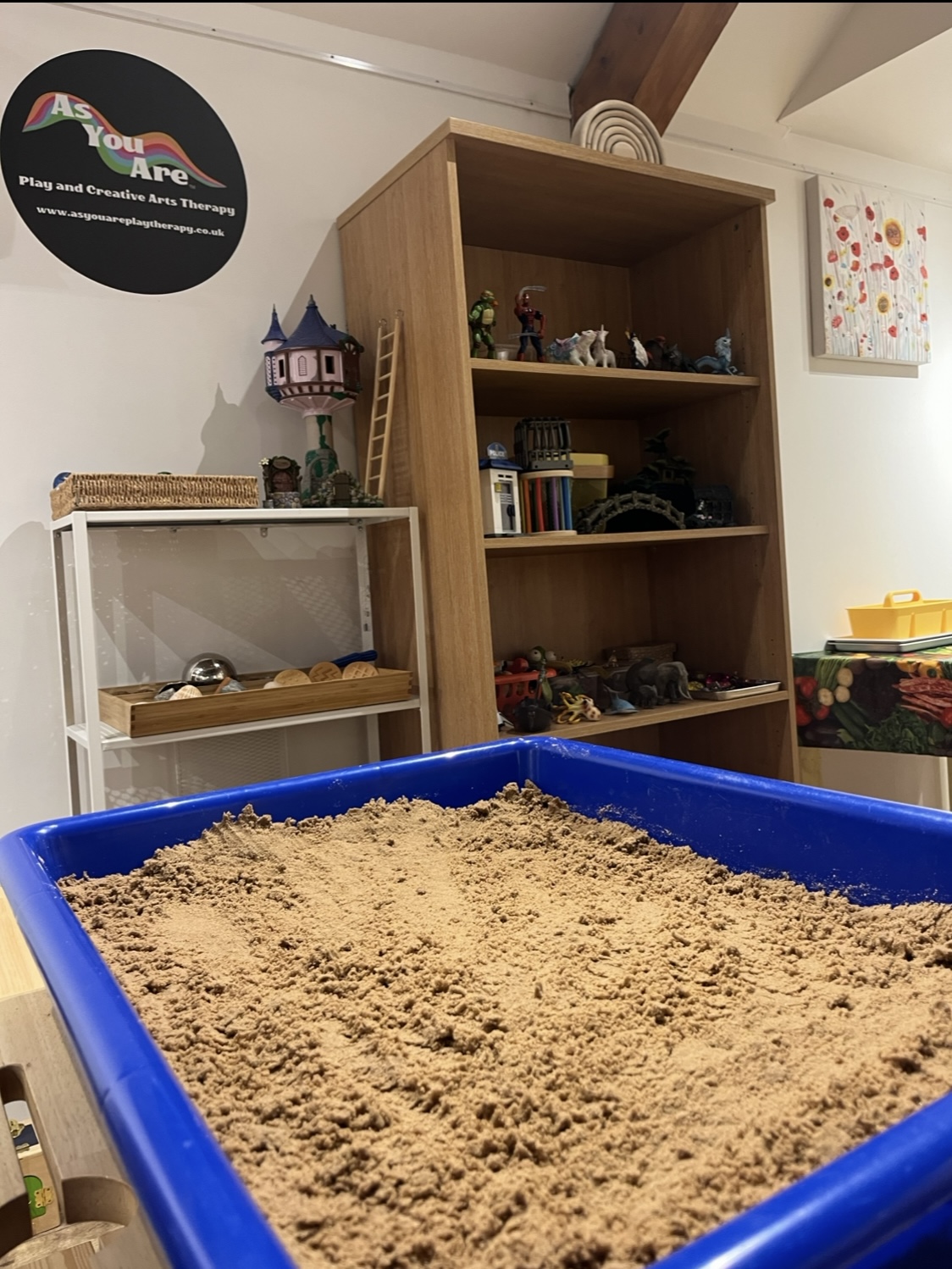
The therapy room contains a wide range of therapeutic resources including sand tray and figures, clay, art materials, paint, crafts, puppets, dressing-up, dolls, small world toys, cars, musical instruments, a piano, movement equipment, a nest swing, masks, punchbag, targets, therapeutic books and stories and sensory resources.
Outdoor sessions may include nature-based activities such as den building, hammocks, swings, natural crafts, woodland exploration, fire pit activities, and creative play within the natural environment.
Will I get into trouble if I tell you something?
You will not be in trouble telling your therapist anything.
Anything you say or do in the therapy will be for you to choose to share with others, and not for me to. Your session is confidential and I will discuss your progress eg your confidence, and not your process eg that you played in the sand tray with a ball. The only time I will have to pass on what you say or do is if it keeps you or someone else safe eg if you tell me someone is hurting you or someone else. That is when I will tell someone else, but I will always tell you I need to before I do.
Can I choose what we do?
Yes, during your sessions you can choose to play with whatever you decide. There are few rules in Play Therapy eg one is that we keep everyone safe.
What if I feel nervous?
It is usual to feel nervous when we are trying anything new. It is ok to feel any emotion, and you will probably find that your nerves will go once the sessions start.
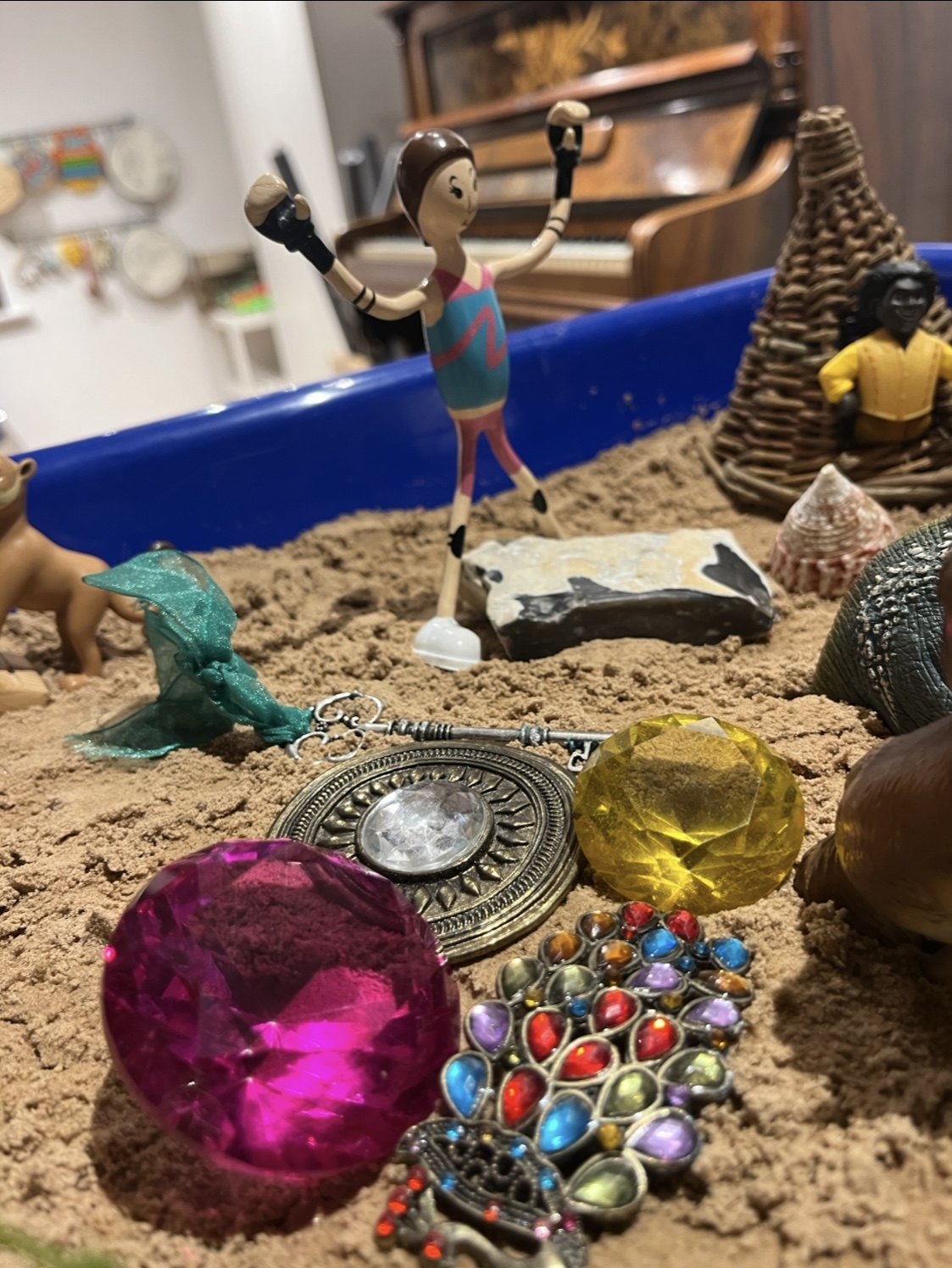

Do you represent all faiths, cultures, abilities, sexual orientations and genders etc in your Play Therapy Toolkit?
Yes. You will find all people represented at As You Are. We are passionate about diversity and inclusivity. Within the toolkit, we have been very mindful to include a wide variety of faiths, cultures, abilities, genders, ages etc to respect and represent the diverse spectrum of humankind. If you notice we are missing anything while you are here, please let us know and we will source and include it in the practice.
How accessible is As You Are?
In terms of physically entering the building there are a choice of steps and a slope/patio to the building entrance. Here there is a slight threshold height which we have a ramp for if required. The building is all on ground level. The toilet is not big enough for a wheelchair unfortunately. The toolkit is all within reach.
Thinking about sensory needs; the building is in a quiet and natural setting without loud noises or harsh lighting or scents. We have noise reducing headphones if required, and many fidget tools.
We are more than happy to read you through any paperwork and fill it in with you, considering literacy requirements. We are available to talk or email/text.
Can I bring a special toy?
One of the few rules of Play Therapy is that nothing comes into or out of the room apart from us. It is to keep the space consistent for you every session. You will find lots of other toys inside that are available to you during the session.
What happens if a session is missed?
Weekly sessions at the same time and place provide consistency, predictability, and support the development of the therapeutic relationship, all of which are important parts of effective therapy.
If a session must be missed, we ask for as much notice as possible. Information regarding cancellations and fees can be found in our Terms and Conditions.
Does therapy go ahead in any weather?
The only times that therapy would not be available due to weather is when it is outdoors or bushcraft Play Therapy and the wind is very strong and dangerous near trees.
Occasionally, it might be impossible or dangerous for you to travel due to snow. However, As You Are is particularly beautiful in the snow so if it is possible that is a great therapeutic opportunity!
What does my child need to wear?
Due to the nature of Play and Creative Arts Therapy, there will likely be mess and please be ready for this as it is important to allow the child to go through the process with the chosen toolkit.
With this in mind, please send your child in clothes and shoes you are happy to get messed up.
Aprons will be offered at the wet art area, however, they will not be imposed.
In addition to the above, for outside therapy, please ensure your child is dressed comfortably and appropriately for the weather.
Can I just stop bringing my child to therapy?
The planned ending is a particularly important part of therapy. A ‘good’ ending enables the child and family to prepare themselves mentally and emotionally for closure and allows trust to remain within all the relationships. It allows the child to go through the process of ending in a positive way when often in life ‘good’ endings are not afforded to us.
Where possible, We encourage families to discuss ending therapy in collaboration with the therapist and child before making a final decision so that appropriate support can be provided.
Particular importance is placed on endings. A planned ending allows children the opportunity to reflect on their therapeutic journey, celebrate their achievements, process feelings about saying goodbye, and experience a healthy, supported transition. Good endings are an essential part of the therapeutic process and help children integrate the work they have undertaken. Indeed, many professionals state that endings; good or bad, have an unprecedented impact upon us in the future. Trust is built, or not, upon the types of endings we experience. It is very important we get this right especially in a therapeutic intervention.
How many children can you see in a school day?
Depending on location and school arrangements, we can typically provide:
• Up to four individual Play Therapy sessions
• Up to four small group sessions
• Four to five parent, carer, or school meeting, depending on length.
• Or a combination of these services
Why aren’t any photos of the children or their creative process on display anywhere?
At As You Are, we take your privacy very seriously. When your child or family attend therapy here, you can be assured that we will not share photos, emotional process creative works, or any other identifying data. We respect your right to privacy during therapy. We follow safeguarding procedures which take precedence and keep everybody safe. We may share our own personal creative works we have completed ourselves or ones from group wellbeing sessions only with permission.
How is Play Therapy different from Filial Therapy?
Play Therapy focuses on the individual child and their therapeutic needs.
Filial Therapy focuses on strengthening relationships between children and their parents or carers by teaching therapeutic play skills that can be used within the family.
Please see our Therapy Services pages for more information about each approach.
Is Play Therapy just playing?
Although it may appear to be “just play” to an observer, Play Therapy is a space where the child may use metaphor, symbolism and their subconscious, innate ability to heal and know themselves through creative mediums.
It is where successful evidence-based practice and neuroscience informed work look ‘just like play’.
As adults, we often dilute the meaning of ‘play’ to mean much less that what it actually means or does. Play is the foundation for all else and is an extremely powerful, essential part of both childhood and adulthood.
The therapist carefully observes, reflects, tracks, and responds to the child’s emotional experience, helping them explore thoughts, feelings, relationships, and experiences through play, and bring a heightened awareness of self.
Children lead the process, allowing therapy to occur in a way that feels natural and meaningful to them.
https://playtherapy.org.uk/in-depth-information-on-how-play-therapy-works/
Is Play Therapy fun?
Often it is.
Play Therapy can include creativity, exploration, enjoyment, and laughter. However, therapy can also feel challenging at times as children process difficult emotions, experiences, and changes.
Through play, children develop resilience, confidence, self-awareness, and emotional wellbeing whilst working at their own pace.
A lot of the child’s process will be subconsciously and symbolically achieved, rather than consciously. The toolkit allows the child to select for themselves which leads to an enjoyment through the therapy and empowerment.
What level of need do you work with?
As You Are Play Therapy can support children experiencing a wide range of emotional, behavioural, social, and mental health difficulties.
Play Therapy UK (PTUK) provides a helpful continuum of need which illustrates the broad range of presenting needs that Play Therapy can support.
https://playtherapy.org.uk/in-depth-information-on-how-play-therapy-works/
What locations do you work in?
As You Are is based in Holmfirth, West Yorkshire and serve;
Holmfirth, Honley, Meltham, Huddersfield, Marsden, Slaithwaite, New Mill, Brockholes, Netherton, Denby Dale, Skelmanthorpe, Kirkburton, Shepley, Penistone, Barnsley, Wakefield, Stocksbridge and surrounding areas throughout the Holme Valley, Colne Valley, Kirklees, South Yorkshire and West Yorkshire.
Please get in touch if you are unsure whether we cover your location.
How do I get there or park etc?
There is on-site free parking. We are accessible by car, or a bus stop is very close.
Can I be late dropping off or collecting my child?
Consistency and predictability are important parts of the therapeutic process.
Sessions are carefully scheduled and timed for each child. Unfortunately, extending sessions due to late arrival or collection is not usually possible.
If you are experiencing difficulties with session times, please contact us and we will do our best to find a solution.
Where can I find more information about Play Therapy?
What is Play Therapy?
https://playtherapy.org.uk/what-is-play-therapy/
How does Play Therapy work?
https://playtherapy.org.uk/how-does-play-therapy-work/
https://playtherapy.org.uk/in-depth-information-on-how-play-therapy-works/
Information for children about Play Therapy
https://playtherapy.org.uk/for-children/
Information for parents about Play Therapy
https://playtherapy.org.uk/for-parents/
Information for schools about Play Therapy
https://playtherapy.org.uk/for-teachers/
Next Steps
Get in touch to chat or visit for a free no obligation initial meeting.