What is Play Therapy?
Play Therapy is a specialised form of psychotherapy designed to support children and young people with their emotional wellbeing and mental health using play as a child’s natural way of expressing themselves and processing thoughts, feelings and their experiences. Children do not always have the words to explain their thoughts, feelings, or experiences, so play provides a natural and comfortable way for them to communicate and process what is happening in their lives.
Play Therapy is an evidence based and successful therapeutic approach which follows the work of Axline, Rogers, Klein, Landreth, Winnicott, Freud.A, Jung and others which put the therapeitic relationship and child central in their healing journey using our innate ability to use the subconscious, symbolism and metaphor to heal and return to our whole selves.
Within a safe, confidential, and accepting environment that the trained therapist creates, children are given the freedom to explore their emotions through play and creative mediums. Sessions are led by the child, allowing them to express themselves in ways that feel right for them, while the therapist acts as facilitator rather than director, observing, hypothesising, reflecting, mirroring and supporting emotional expression and therapeutic guidance throughout the process.
A variety of creative resources may be used, including art materials, sandtray and symbolic figures, clay, storytelling, puppets, music, movement, imaginative play, and nature-based activities. These mediums, alongside the therapeutic relationship, can help children explore experiences, build self-awareness, develop emotional regulation, and strengthen confidence and resilience. With the expertise of the therapist who brings the principles and ethics within the therapy, and most importantly, the therapeutic relationship.
Play Therapy can benefit children facing a wide range of challenges, including anxiety, low self-esteem, bereavement, family changes, trauma, friendship difficulties, behavioural concerns, and emotional distress or maybe the child would simply benefit from their own dedicated special time every week. By providing a trusting therapeutic relationship and a space where children feel heard and accepted, Play Therapy supports healing, personal growth, and positive emotional development.
Next Steps
Get in touch to chat or visit for a free no obligation initial meeting.
Reasons for Referral for Play Therapy
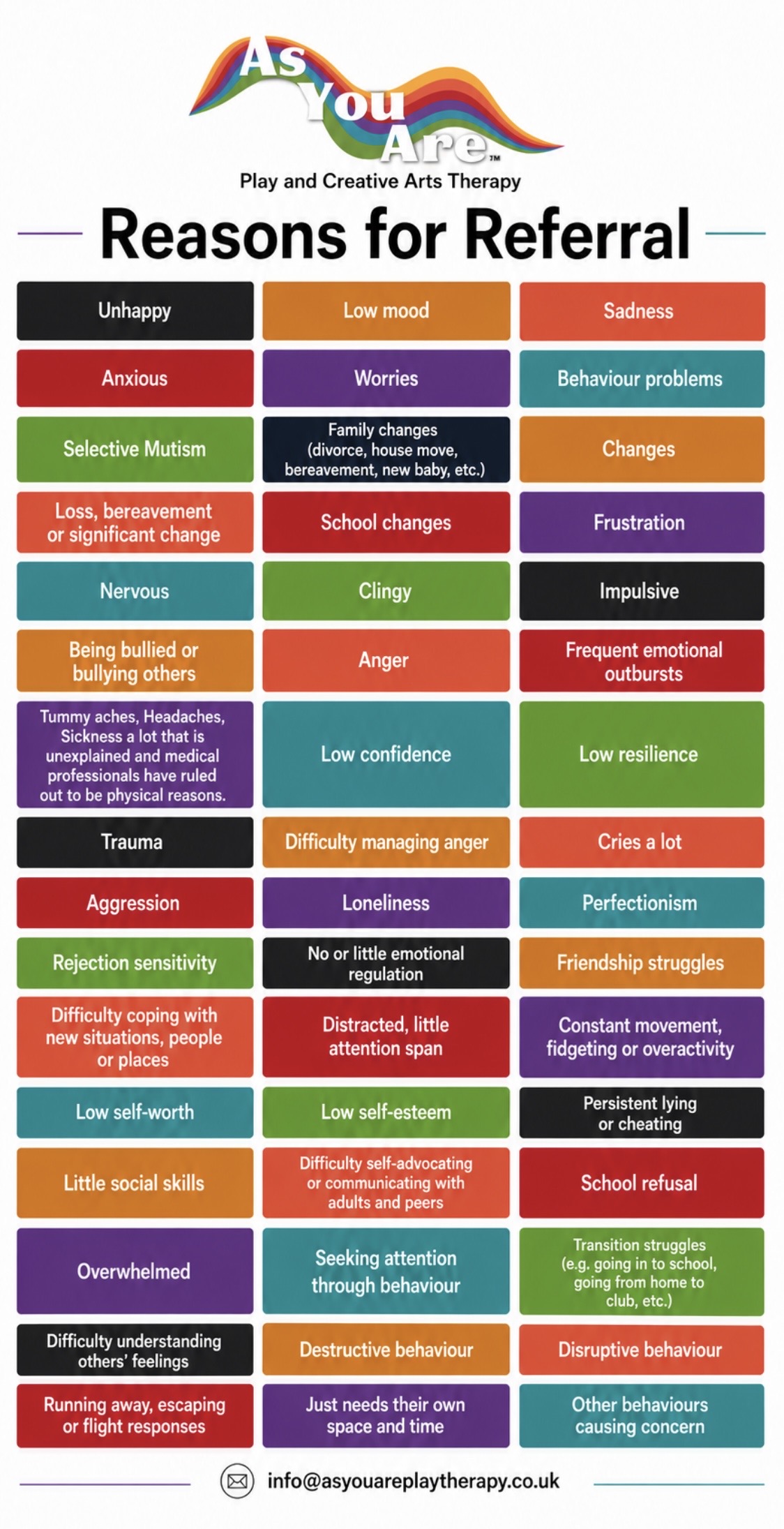
There are many reasons why a child might be referred to Play Therapy and at As You Are they can also refer themselves, through school or parent support.
They might have a presenting problem or they might need their own time and space for whatever reason.
Is your child unhappy, have low mood or sadness that seems more than usual to you? Do they cry often or are inconsolable?
Are there lots of worries or anxiety that you have noticed?
Are you concerned that your child is so shy or timid that it stops them from enjoying themselves or living a life you want for them?
Perhaps you are aware of behaviour problems that are affecting your child at home or school?
More Referral Reasons
Or maybe your child is not speaking for whatever reason and could be displaying selective mutism?
Have there been family or other changes eg divorce, house move, loss, bereavement, new baby, etc.
Or perhaps a change of school or within school or friendship struggles?
Have you noticed more frustration in your child or are they displaying frequent emotional outbursts?
Is your child being bullied, or bullying others?
Has your child shown more nervous behaviour or more clingy than usual?
Maybe they are very impulsive and acting before thinking often?
Is your child very angry often and/or finds it hard to calm down?
Maybe they find their anger hard to manage?
Maybe they are aggressive towards you or others and you don’t know what to do?
Sometimes tummyaches, headaches, sickness etc that is unexplained and where medical professionals have ruled out physical causes can be a sign of an emotional response.
Is there a nagging feeling for you that your child has low confidence or low self esteem and you know you have to find a way to help them?
Do you wish they had more self worth?
Have you noticed that your child has low resilience to situations where you feel they could be fine given a bit of support with it?
Do you know that your child has suffered trauma or complex trauma and that more can be done to support them to work through it?
Is there a feeling of loneliness or isolation within your child and you feel helpless?
Does perfectionism stop them doing things or from beginning something in the first place?
Or they don’t feel good enough to give things a go?
Do they see things differently from others or become really sensitive and upset about a perceived rejection?
Do they catastrophise and take things out of context?
Do you feel they are extra sensitive to any sort of rejection, comments or situations?
Is there no or little emotional regulation?
Are they struggling with friendships or can’t make friends due to their lack of social skills or other hurdle?
Does your child have difficulty coping with new situations, people or places?
Are they distracted, with little attention span?
Or maybe there is constant movement, fidgeting or overactivity in your child?
Have you noticed persistent lying or cheating?
Do you want your child to become self-advocating or communicating with adults and peers more?
Have you noticed that your child needs their own time and space and that’s not possible at home or school?
Or maybe you know how much they would benefit from their own special play therapy time?
Are they refusing to go to school and you are at a loss what to do?
Is your child often in a state of overwhelm or finds things overwhelming?
Do you feel like your child is seeking attention through their behaviour?
Have you noticed your child struggles with transitions e.g. going into school, going from home to club, etc.
Does your child have difficulty understanding others’ feelings or relating to others?
Do you feel they miss social cues others their age pick up on?
Have you noticed disruptive behaviour or destructive tendencies?
Does your child run away, or display escaping or flight responses?
Are there any other behaviours that are causing concern or you feel your child needs help with?
Get in touch and we can talk it through. Play Therapy might be helpful and As You Are might be the place to be for what you need.
How can Play Therapy help?
As You Are Play and Creative Arts Therapy can support children, young people and families in many different ways. Often, it is not about “fixing” a problem, but providing a safe, accepting space where a child can be fully themselves, make sense of their experiences, and develop the inner resources they need to thrive.
As You Are Play and Creative Arts Therapy offers something many children rarely experience in today’s busy world:
- A space that belongs entirely to them.
- A space where they can explore, create, play, feel, think, wonder, heal, and simply be.
- A space where they are accepted exactly as they are
- A space where they discover that they already carry many of the strengths, resources, and answers within themselves and gain the confidence to use them.
- A space where there is no pressure to speak, where they may use their natural language of play to express themselves, or process thoughts and feelings.
- A space where they may use metaphor, symbolism and their subconscious, innate ability to heal and know themselves through creative mediums.
- A space where successful evidence-based practice and neuroscience informed work look ‘just like play’.
Their space. Their time. Their voice. Their journey.
Helping Children
As You Are Play and Creative Arts Therapy can help children:
• Express thoughts, feelings, and experiences that may be difficult to put into words
• Process emotions such as sadness, anger, worry, fear, grief, confusion, or frustration
• Build confidence and self-esteem
• Develop resilience and coping skills
• Improve emotional wellbeing
• Increase self-awareness and understanding of themselves
• Feel heard, understood, accepted, and valued
• Develop trust and healthy relationships
• Strengthen communication skills
• Improve social skills and friendships
• Build empathy and understanding of others
• Learn emotional regulation and self-soothing strategies
• Feel calmer and more settled
• Explore challenges and find their own solutions
• Develop problem-solving and decision-making skills
• Gain a sense of autonomy, choice, and control
• Feel safe, secure, and supported
• Experience acceptance without judgement
• Develop a stronger sense of identity and belonging
• Process difficult life events, transitions, loss, separation, trauma, or change
• Increase concentration and emotional readiness for learning
• Develop creativity, imagination, and curiosity
• Reconnect with joy, playfulness, and fun
• Build hope and optimism for the future
• Develop courage to face challenges
• Experience success and achievement
• Strengthen mind-body awareness and connection
• Release pent-up emotions, worries, tension, and energy in healthy ways
• Learn healthy boundaries
• Develop independence and confidence in their own abilities
As You Are Outdoor Play Therapy and Nature-Based Play Therapy can also help children:
• Reconnect with nature and the natural world
• Experience freedom and space away from everyday pressures
• Develop confidence through manageable risk-taking and challenge
• Build resilience through real-life problem-solving experiences
• Improve physical wellbeing and movement
• Feel grounded, calm, and regulated through sensory experiences
• Develop environmental awareness and stewardship
• Experience wonder, adventure, and discovery
• Strengthen connection with themselves, others, and the wider world
• Benefit from the restorative and calming effects of nature


Confidence has sky rocketed
"Definitely much better emotional awareness. Aware of his triggers, better setting boundaries; tells them and vice versa at home. His confidence has sky rocketed, really come on. More able to trust I’m still there, better, more secure in self and chill anywhere."
Parent, Colne Valley

Less negative self talk
"His self love is growing now, proud of himself and less negative self talk. He plays really well at school now and maintaining friendships is not an issue now. He can take responsibility and is self aware now. Talks openly more."
Teacher, Calderdale